FAIRFIELD POLICE CADETS
  • Home
  • About Us
    • About Us
    • Police Leadership
    • Cadet Leadership
    • History
    • Awards & Citations
    • Newsletter
    • Cadet Honor Roll
  • Contact Us
    • Join the Post
    • Donate
  • Community Projects
    • Car Show
    • Shred Day
    • Fairfield County Cadet Leadership Conference
    • Lock Your Car!
    • Purple Heart Project
  • Members Menu
    • New Cadet Info
    • Training Portals
    • Academy
    • Calendar
    • Comment/Complaint
  • Home
  • About Us
    • About Us
    • Police Leadership
    • Cadet Leadership
    • History
    • Awards & Citations
    • Newsletter
    • Cadet Honor Roll
  • Contact Us
    • Join the Post
    • Donate
  • Community Projects
    • Car Show
    • Shred Day
    • Fairfield County Cadet Leadership Conference
    • Lock Your Car!
    • Purple Heart Project
  • Members Menu
    • New Cadet Info
    • Training Portals
    • Academy
    • Calendar
    • Comment/Complaint

Promotional Study Guide for Sergeants

The following information is the building blocks of criminal justice knowledge that all police officers are expected to be familiar with. For those cadets who want to enter leadership positions, they must be knowledgeable in these topics so that they may be called upon by advisors to give instruction during meetings/events.

Power Point

Key Concepts

Control-Before-Cuff
Always have complete control over a suspect before even taking your handcuffs out in preparation of cuffing a suspect. If the suspect sees the handcuffs come out before you are ready, they might start to fight. You want total control of the suspect when you start to place handcuffs on them, because fighting someone while attempting to handcuff them creates an increased officer safety hazard.
Attention to Detail
This is an overall concept that covers an attitude you must have. Attention to detail means making sure your uniform is squared away, or picking up on little details the average person might miss.
Examples:
  • You arrive on scene to a house alarm early in the morning. You see wet footprints on the walkway indicating someone has recently been there.
  • You arrive on scene to a 911 hang-up. The person who answers the door says everything is okay and  that their child was playing with the phone, but you see that the person's face is read and is sweating.
  • You arrive on scene to a domestic violence call. The male subject is on parole and knows if he gets arrested he might go back to jail. He looks at your uniform and sees that your shirt is tucked in, your shoes are shined, and you maintain your interview stance the entire time you speak with him. Your demeanor and presentation stops him from seeing an opening to run away or attack you.
  • While driving down a street you see several car doors have been left slightly open, and you remember a group of teenagers were just walking from the area and avoided making eye contact with you as you drove by.
This is something that you will pick up over time through training and experience.
Ask - Tell - Make
If you want someone to follow a direction, the best thing to do is to ask them to do it of their own free will.
  • "Sir, would you mind standing over here while I talk with you?"
If the person does not comply, and this is something you need them to do for officer safety, tell them to do it with more authority.
  • "Sir, stand over here and don't walk away from me."
If the person again does not comply, you can "make" them follow your lawful order with a reasonable amount of force. In this scenario, you could guide the subject to a chair or even use handcuffs to control their movement depending on if they are a suspect or being a threat to officer safety.

Responding to a Call

The Basics
Step 1: Tell dispatch that you've arrived on scene.
Step 1: Secure the scene - make sure it's safe
Step 3: Does anyone need medical attention?
Step 4: Evaluate what's going on
Step 5: Take Appropriate Action
Pedigree Information
Any time we talk to someone, we ask for pedigree information
  • Name (first and last)
  • Date of Birth
  • Address
  • Phone number

Check Your Subject

Any time we talk with a suspect (or victim/complainant) we check with dispatch to see if they have any warrants. That means "running" the person's name and date of birth with dispatch.
DMV - Department of Motor Vehicle records are used to confirm identities, as well as confirm their license status. When you check someone's records in DMV, you can use their name & date of birth, or license number. You can check someone by just their first and last name, but keep in mind there are many people with the same name and this isn't always an effective method. The best way is to use their license number - the next best way is with their name and date of birth.

NCIC
- National Crime Information Center is a criminal records database which allows criminal justice agencies to enter or search for information about stolen property, missing persons, wanted persons, domestic violence protection orders. Additionally, it is used to access criminal histories and the sex offender registry.

MNI
- Master Name Index is an internal database used by police departments to keep track of the people they come in contact with. Someone may not have a criminal record, but they might have police contact within your jurisdiction that you can look up to get an idea of who you are dealing with. You can't see other town's  MNI databases, but you can always call them and ask them about a person.

This is a good way to find phone numbers, relatives, or known associates if the person has been a suspect or involved in other Fairfield cases in the past.

Fourth Amendment

The right of the people to be secure in their persons, houses, papers, and effects, against unreasonable searches and seizures, shall not be violated, and no Warrants shall issue, but upon probable cause, supported by Oath or affirmation, and particularly describing the place to be searched, and the persons or things to be seized.

Types of Suspicions

A Hunch: A gut feeling that a crime was in the process of being committed, had been committed or was going to be committed very soon.

Reasonable Articulable Suspicion: facts and circumstances that would lead a reasonable person to suspect that a crime was in the process of being committed, had been committed or was going to be committed very soon.
  • The threshold an officer needs to conduct a motor vehicle stop
  • The threshold an officer needs to conduct a pat-down
  • The threshold an officer needs to detain someone until it is determined that a crime has or has not occurred

Probable Cause: facts and circumstances provided leading a reasonable person to believe that the crime was in the process of being committed, had been committed or was going to be committed very soon.
  • The threshold an officer needs to arrest someone
  • The threshold an officer needs to write an arrest or search warrant
  • The threshold an officer needs to search a vehicle
What is a search warrant?
A judge issues a search warrant to authorize law enforcement officers to search a particular location and seize specific items. To obtain a search warrant, police must show probable cause that a crime was committed and that items connected to the crime are likely to be found in the place specified by the warrant. There are several exceptions to needing a search warrant which would allow an officer to conduct a search without needing authorization.


  • Consent. Police may conduct a search without a search warrant if they obtain consent. Consent must be freely and voluntarily given by a person with a reasonable expectation of privacy in the area or property to be searched.
  • Plain View. An officer may seize evidence without a warrant if an officer is on the premises lawfully and the evidence is found in plain view.
  • Search incident to arrest. While conducting a lawful arrest, an officer may search an individual's person and their immediate surroundings for weapons or other items that may harm the officer. If a person is arrested in or near a vehicle, the officer has the right to search the passenger compartment of that vehicle.
  • Pat Down. If an officer has reasonable suspicion to believe that a subject is armed and dangerous, the officer can conduct a pat down for weapons only. If during the pat down, the officer immediately recognizes contraband, that contraband can be seized.
  • Exigent Circumstances. Police are not required to obtain a search warrant if they reasonably believe that evidence may be destroyed or others may be placed in danger in the time it would take to secure the warrant.
  • Hot Pursuit. Police may enter a private dwelling if they are in "hot pursuit" of a fleeing criminal. Once inside a dwelling, police may search the entire area without first obtaining a search warrant.
  • Community Care-taking Function. It is common practice for people to turn over to police property they find and for police to come across abandoned property.  In either case, such property can be searched without a warrant.
  • Automobile Exception. An officer may search a vehicle if they have a reasonable belief that contraband is contained inside the vehicle.
The Exclusionary Rule
When the government violates the Fourth Amendment by conducting a warrant-less search without a valid exception the exclusionary rule may apply. Under the exclusionary rule any evidence obtained as a result of an unlawful search will not be permitted to be used at trial. As with all general rules, however, there are exceptions to the exclusionary rule.
  • Good Faith: If the police make a reasonable mistake in conducting a search, evidence of a crime that they find as a result may be admissible. The U.S. Supreme Court has ruled that a court can consider evidence obtained from a search that appeared to have a lawful basis, such as a search supported by a warrant. If the warrant later turns out to have been invalid, the police may not be held accountable for conducting a search while relying on it.
Fruit of the poisonous tree
is a legal metaphor used to describe evidence that is obtained illegally. The logic of the terminology is that if the source of the evidence or evidence itself is tainted, then anything gained from it is tainted as well.

Picture

Building Searches - Key Concepts

Concealment Vs. Cover
  • Concealment is something that can hide you visually from a suspect, but will not protect you from bullets.
    • Examples: a regular wall in a house, a car door, a fence, a bush, etc.
  • Cover is something that can hide you visually from a suspect, and will protect you from bullets.
    • Examples: The engine of a car, concrete barriers (depending on the type of bullet being shot at you), the wheel-well of a car, dirt mounds, brick walls, large rocks etc.
Picture
"Slicing the Pie"
The following video provides a good visual demonstration of "pie'ing" or slicing the pie. A major difference you must note is that unless presented with deadly physical force, police give commands to people they find in rooms. We do not immediately shoot someone we find during a building search.
Picture
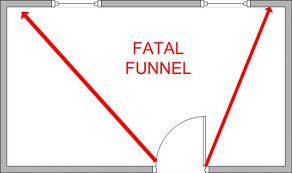
Fatal Funnel
  • A fatal funnel is any area where the Officer is exposed to possible gun fire from an open room, hallway, doorway or window.
  • There is no cover or concealment in a fatal funnel, and the Officer must clear these areas rapidly.

What to do with Suspects

Giving Commands
How and when you give commands is different based on the situation you are in. If the subject is armed and dangerous, you are going to be giving specific commands for the suspect to drop their weapon, go face down on the ground, and place them in the lockup position. For other situations, your commands may be as simple as telling the person to turn around and place their hands behind their back, and they'll willingly comply. There is an in between that you will have to adapt to, depending on the suspect, crime, and situation. A few concepts remain the same no matter what situation:
  • Be clear and concise - be as simple as you can with your commands so that anyone can understand what you are telling the person to do. If you are not clear, then they cannot follow instructions, and that's not good for anyone.
  • Give one command at a time - The suspect is in a stressful situation. They are about to be detained or arrested, so their brains can't handle more than one command at a time. Giving them multiple commands could cause them to do something you don't want them or expect them to do.
  • One person gives commands - One person should be giving commands to a single person. Multiple officers giving commands at once will result in confusion and could cause the suspect to do something unexpected simply because they're trying to obey someone's commands.

Difference between Detention and Arrest (Fourth Amendment Cont.)
Police can detain someone if they have reasonable suspicion that a crime exists, and for as long as is reasonable for the officer to determine if a crime has been, is about to be, or is being committed.
  • What is a detention? Detaining someone is a seizure of a person and it could be as simple as telling a person "hey, come over here" or ordering them to stay where they are. Handcuffing or placing someone in the back of a patrol car can also be used as a way to detain someone if they are being resistant. The key is that the person does not feel like they are free to leave.
  • So I can handcuff someone and they're not under arrest? - Yes, but you should always be clear with the person that they are not under arrest, but they are only being detained.
  • So what does under arrest mean? - Someone is under arrest if you have probable cause to believe they committed a crime and you take them into custody. This does not mean they have handcuffs on, it simply means the person (or any reasonable person) believes they are under arrest.

When can you search a suspect? (More Fourth Amendment)
Mentioned above in the Fourth Amendment Section was Pat Downs and Search Incident to Arrest
  • Pat Downs, also called a "Terry Frisk" refers to when an officer searches a person for weapons and only weapons.  This is limited to when an officer has reasonable suspicion that the person is armed and dangerous. We do not ask a subject for consent to check their person for weapons, in fact in CT we are not allowed to ask. If you have reasonable suspicion that a pat down can be conducted, you simply tell the person you are going to do it.
    • The search consists of patting a person's outer garments for the feel of a weapon. The officer cannot grab or press hard against the person to try and ascertain what the item is specifically.
  • Search Incident to Arrest is done when a subject is being arrested. When a suspect is arrested, a complete search and removal of all items in their pockets is conducted.

Miranda Rights/Miranda Warnings
Miranda Warnings are given to a suspect when they are detained and being questioned about a crime. Remember, if the subject believes they are being detained, the law considers them detained.  For example,
  • The suspect comes to the police department of their own free will to discuss a case. They are brought to a room that is located through several doors that require a key card to get through. The suspect is brought into an office, the door is closed and an officer is standing at the door. The suspect is questioned about their involvement in a crime. No reasonable person would believe they are free to leave, and this requires Miranda Warnings.
  • The suspect is in the main lobby of the police department. They came at their own free will to discuss a case and during the questioning, they incriminate themselves. This does not require Miranda Warnings.
  • The suspect is detained in the back of a police car. You are driving them to the police department and not asking any questions. The suspect, without prompting, makes incriminating statements. This does not require Miranda Warnings.
  • You meet with a suspect in their own home to talk about a case. The suspect invites you in and agrees to answer your questions. This does not require Miranda Warnings.
  • You arrive at a domestic violence call and discuss with each party what had occurred. Subject 1 is determined to be the offender, and is placed in handcuffs. Any further questioning from that point on requires Miranda Warnings.
Bonus Material
ABOUT

The Post

Advisors

Structure

History

Cadet Honor Roll

Contact us

Join the Post

Request information


DONATE!
Members

New Member Application

Training Portals

Phone: 203-254-4865
Address: 100 Reef Rd, Fairfield Connecticut